Introduction. Post-traumatic stress disorder (PTSD) and chronic pain syndrome (CPS) represent complex multifactorial pathological conditions that involve a wide spectrum of interacting mechanisms, including: nociceptive components; neuropathic dysfunctions; central sensitization processes; autonomic nervous system dysregulation. Based on contemporary clinical evidence, the integration of multiphysical therapeutic modalities—such as transcutaneous electrical nerve stimulation (TENS), pulsed electromagnetic field therapy (PEMF), and low-intensity pulsed ultrasound (LIPUS)—implemented in accordance with classical anatomical and atlas-based frameworks [1–11], demonstrates statistically and clinically significant improvements, including [12–17]: reduction of pain intensity by 32–38%; increase in functional mobility by 18–22%; improvement of psycho-emotional indicators by 25–40%. However, despite these promising outcomes, a critical limitation persists: the absence of a formalized and reproducible methodology for selecting therapeutic intervention zones, which consequently results in variability of treatment outcomes across clinical contexts [15]. Furthermore, an equally important aspect of therapeutic intervention is the necessity to validate the correctness of the selected treatment focus, particularly in relation to the integrated diagnostic framework linking: primary cause → etiology → nosological form → clinical manifestation. This requirement has necessitated the inclusion of at least one diagnostic trigger point, capable of confirming the relevance and correctness of the selected multipoint therapeutic configuration. Objective.The aim of the present study is to develop a multi-atlas system for the identification of therapeutic and diagnostic zones, based on the integration of: classical anatomical atlases; geometric and topological algorithms; biophysical modeling approaches; artificial intelligence-based decision logic, with the formation of a standardized therapeutic framework consisting of: six therapeutic intervention points and one diagnostic validation point (6+1 model) validated within the rehabilitation context of post-traumatic stress disorder and chronic pain syndrome.
Materials and Methods. The proposed system is based on the integration of:
authoritative anatomical and clinical atlases [1–9]; specialized atlas-based and neurovascular mapping publications [10, 11]; original clinical research conducted at NTU “KhPI” between 2023 and 2026 [12–17]. Within this framework, particular emphasis is placed on the conceptual synthesis of atlas-based diagnostic zones with geometric and artificial intelligence algorithms, forming a unified methodology for constructing multipoint therapeutic models. Multi-Atlas Integration Concept. The theoretical basis of the model is defined by the principle of: clinically constrained multi-atlas integration. This principle is formalized through the introduction of a spatial-functional matrix (S-matrix):
Si=f(Ai,Fi,Ni,Vi,Di) (1)
where: Ai— anatomical structural component; Fi — fascial integration parameter; Ni — nociceptive status; Vi — autonomic regulation parameter; Di — distal projection factor.
Thus, each candidate therapeutic point is evaluated as a multidimensional node within a unified clinical-biophysical coordinate system. Geometric and Computational Algorithms. To ensure objectivity and reproducibility in zone selection, the following computational approaches are implemented: three-dimensional spatial coordinate mapping (3D mapping); vector analysis of fascial tension distribution; topological modeling of trigger point networks; wave-based biophysical coherence models. The final selection of therapeutic zones is determined using the optimization function:
F =argmax∑ wi Si (2)
which ensures maximal clinical efficiency of the selected intervention set. Artificial Intelligence Decision Layer. At the algorithmic level, the system incorporates a multiparametric AI-based decision framework, including: impedance analysis of biological tissues; heart rate variability (HRV) analysis; pathological clustering and classification; automated selection of therapeutic and diagnostic points. This approach is consistent with the concept of: adaptive multiphysics feedback control which enables real-time adjustment of therapeutic interventions.
Results: Formation of the 6+1 Model. The proposed model was validated through clinical application in: 160 patients with PTSD [12, 17]; 60 patients with chronic pain syndrome [13-17], as described in detail in previous studies [12–17]. Structure of Diagnostic and Therapeutic Points. Diagnostic Point (Primary) Chapman trigger point. Functions: verification of pathological state;
assessment of primary autonomic response. Evaluation parameters: tissue impedance; pain sensitivity; local bioelectrical potential. Therapeutic Points (Six p1-p6 Core Points): Central paravertebral zone → autonomic regulation (p1); Fascial key point → tension release (p2); Myofascial trigger point (Travell) → local ischemia modulation (p3); Vascular window (Stecco) → enhancement of signal penetration (p4); Distal somatotopic point (Su Jok) → neurogenic modulation (p5); Sympathetic ganglion zone → systemic autonomic regulation (p6). Physiological Mechanism of Action. The therapeutic system operates through a cascade of biophysical processes:
Δζ→Δmicrocirculation→ΔECM→ΔANS→ΔCNS→ΔpainΔζ→Δmicrocirculation →ΔECM →ΔANS →ΔCNS →Δpain (3)
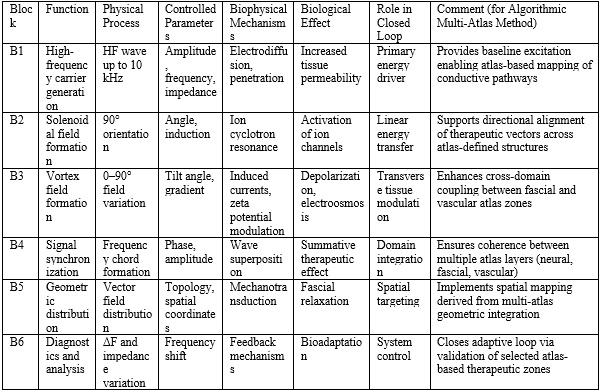
This cascade (3) reflects the interrelation between electrokinetic modulation and systemic physiological adaptation. Confirmed Clinical Effects. According to clinical validation studies [12–17] by (1)-(3), the following effects have been observed: reduction in pain intensity (VAS) by 30–40%; increase in heart rate variability (HRV); improvement in tissue perfusion by 16–22%; reduction in central sensitization index (CSI). Clinical Application (MAGNUZ–MUFLON System). The proposed system (block B1-B6) is implemented using the MAGNUZ–MUFLON, which integrates: PEMF; TENS; LIPUS; VR-based biofeedback; combined with real-time telemetry (table 1) and standardized operating procedures (SOP) [12, 17], including: system calibration; safety control; therapeutic standardization. As a result, the proposed multi-atlas system is grounded in classical anatomical, fascial, neurophysiological, and reflexive atlases [1–11], and is further validated by recent multiphysics rehabilitation studies [12–17]. The proposed model effectively eliminates the randomness inherent in conventional selection of therapeutic zones, as it is fully grounded in evidence-based anatomy, structured atlas integration, and quantitative computational modeling (1)-(3).
Table 1. Extended Functional-Biophysical Table of Method Implementation
Furthermore, the introduction of a diagnostic validation point combined with multi-atlas therapeutic targeting allows for a standardized and reproducible treatment protocol, particularly relevant for complex conditions such as PTSD and chronic pain syndrome. Thus, the proposed model significantly enhances treatment reproducibility, predictability, and overall clinical effectiveness.
Conclusions. The proposed multi-atlas system provides a formalized methodology for the identification of therapeutic and diagnostic zones. A universal “6 therapeutic + 1 diagnostic” model has been developed and validated in 160 PTSD patients and 60 CPS patients. The presented approach significantly improves reproducibility and clinical consistency in the treatment of PTSD and chronic pain syndrome. The MAGNUZ–MUFLON system serves as a practical implementation platform for multiphysics therapy, which is currently being transitioned to advanced clinical trials under standardized SOP frameworks and randomized study protocols (RST), with the aim of regulatory certification in accordance with MOH and FDA requirements.
REFERENCES
1. Standring S., ed. Gray’s anatomy: The anatomical basis of clinical practice. 42nd ed. Elsevier, 2021.
2. Netter F. H. Atlas of human anatomy. 7th ed. Elsevier, 2019.
3. Rohen J. W., Yokochi C., Lütjen-Drecoll E. Color atlas of anatomy: A photographic study of the human body. 8th ed. Wolters Kluwer, 2016.
4. Stecco C. Functional atlas of the human fascial system. Elsevier, 2015.
5. Myers T. W. Anatomy trains: Myofascial meridians for manual and movement therapists. 4th ed. Elsevier, 2020.
6. Schünke M., Schulte E., Schumacher U., Voll M. PROMETHEUS atlas of anatomy: General anatomy and musculoskeletal system. 3rd ed. Thieme, 2021.
7. Travell J. G., Simons D. G. Myofascial pain and dysfunction: The trigger point manual. 2nd ed. Williams & Wilkins, 1999.
8. Chapman F., Chapman O. Reflexes in the diagnosis of disease. American Journal of Osteopathy. 1937.
9. Park J. H., Woo S. Su Jok acupuncture: Korean hand therapy. Su Jok Academy, 2015.
10. Stecco A., Stecco C. Fascial manipulation for internal dysfunctions. Piccin, 2018.
11. Crossman A. R., Neary D. Neuroanatomy: An illustrated colour text. 6th ed. Elsevier, 2019.
12. Fyk M. I., Tkachenko V. V., Sochnieva A. L., Krytsak V. V., Tkachenko V. I. та ін. Bioresonance therapy in the rehabilitation of post-traumatic syndromes using the multiphysics device Muflon X. Ukrainian Journal of Military Medicine. 2025. № 6(3). С. 130–139.
13. Fyk M. I., Sochnieva A. L., Tkachenko V. V., Krytsak V. V., Tantsura Y. O. Multiphysical neuromodulation and controlled micro trophic regulation for chronic pain rehabilitation by Magnuz–Muflon system. In: Kipensky A. V., ed. VI International scientific and practical conference “Nation’s health and improvement of physical and sports education”. Kharkiv: NTU “KhPI”, 2026. P. 38–41. ISBN 978 617 7988 44 0.
14. Fyk M. I., Tkachenko V. V., Sochnieva A. L., Kritsak V. V. Biophysical concept of multilevel electromagnetic modulation: Control of zeta potential and tissue redox state in the therapy of complex psychosomatic disorders. In: Sokol E. I., ed. Information technologies: science, engineering, technology, education, health. XXXIV International Scientific and Practical Conference MicroCAD 2026. Kharkiv: NTU “KhPI”, 2026. P. 1230. ISSN 2786 9253.
15. Sochnieva A. L., Fyk M. I., Tkachenko V. V., Kritsak V. V. Multi atlas integration and algorithmization of multiphysics intervention zones in the “MAGNUZ–MUFLON” system. In: Sokol E. I., ed. Information technologies: science, engineering, technology, education, health. XXXIV International Scientific and Practical Conference MicroCAD 2026. Kharkiv: NTU “KhPI”, 2026. P. 1231.
16. Tkachenko V. V., Fyk M. I., Sochnieva A. L., Kritsak V. V. Electroosmotic modulation of the fascial matrix: A new approach to overcoming tissue barriers in bioelectronic medicine. In: Sokol E. I., ed. Information technologies: science, engineering, technology, education, health. XXXIV International Scientific and Practical Conference MicroCAD 2026. Kharkiv: NTU “KhPI”, 2026. P. 1232.
17. Piontkovskyi V. K., Fyk M. I., Ponomaryov V. I., Tkachenko V. V., Sochnieva A. L., Kritsak V. V., Tantsura Y. O., Tkachenko V. I., Yakovenko S. V., Akhmedova K. M. Biophysical foundations of gadget oriented telerehabilitation: Towards standardized multimodal protocols in modern physiotherapy in Ukraine. Bulletin of Problems in Biology and Medicine. 2026. № 2(181). P. 228–236.
|










 Голосування

 Ця робота ліцензується відповідно до Creative Commons Attribution 4.0 International License
 Знайшли помилку? Виділіть помилковий текст мишкою і натисніть Ctrl + Enter